








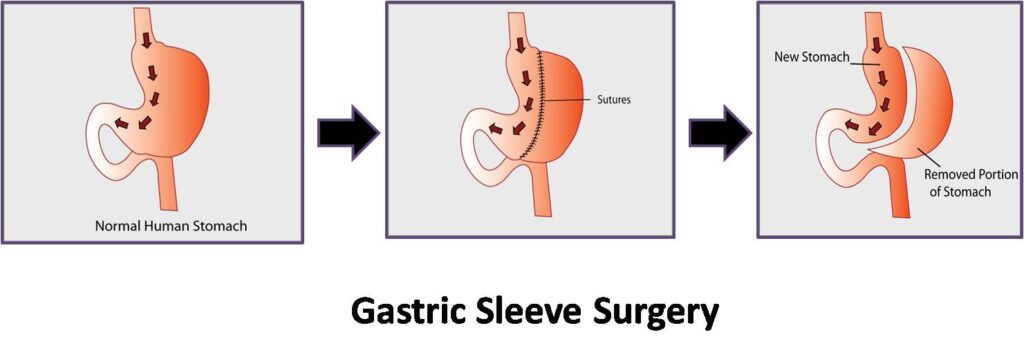
Gastric Sleeve Surgery
(Vertical Sleeve Gastrectomy or Vertical Gastrectomy)
Alternative names: vertical sleeve gastrectomy, sleeve gastrectomy, greater curvature gastrectomy, parietal gastrectomy, gastric reduction and vertical gastroplasty.
Gastrectomy is a combination of two Latin words: gastro, meaning “stomach,” and -ectomia, which means “to cut out.”

Gastric sleeve surgery is one of the newest innovations in bariatric surgery. The most important thing to know about gastric sleeve surgery is it is typically used for those who are excessively obese or too sick to get the other forms of weight loss surgery such as gastric bypass surgery and gastric banding surgery.
It is used to safely start the weight loss surgery journey in those that cannot undergo other types of surgery due to their excessive weight or their health.
The gastric sleeve allows people who fall into the two aforementioned categories reach a safe and healthier weight that will allow them to get a more invasive weight loss surgery such as duodenal switch surgery or gastric bypass surgery. This sleeve has been shown to be the most useful weight loss “kick-off” for people who are considered high risk. It helps them to lose weight easier and faster without any major significant risks they would experience with other weight loss surgeries.
Is Gastric Sleeve the Right procedure for you?
The current scientific literature supports use of sleeve gastrectomy as a primary bariatric procedure. This means that the indications for the sleeve are the same as other covered procedures such as gastric bypass or adjustable gastric banding. The National Institutes of Health (NIH) requires a body mass index (BMI) greater than 40. This is the equivalent of being about 100 pounds overweight for men and 80 pounds overweight for women. People with BMIs between 35 and 39 may also be candidates for weight loss surgery if they have obesity-related illnesses such as diabetes, high blood pressure or high cholesterol.
Gastric sleeve surgery also may be appropriate for people who can't return as often for the follow-up visits required by gastric banding procedures such as Lap Band surgery or Realize Band surgery.
Patients who should consider this procedure include:
- Anyone who is afraid of the long-term results of an intestinal bypass, including problems such as protein deficiency, anemia, ulcers, and intestinal obstruction.
- Those who do not want a foreign object inside their abdomen such as with a Lap Band procedure which is also fairly popular but comes with a number of risks.
- Those who cannot opt for traditional weight loss surgery due to the fact that they have a serious medical condition such as Crohn’s disease, anemia, or an extensive history of other surgeries.
- Any person who takes anti-inflammatory medications because of the fact that they need to be avoided after a gastric bypass procedure. This is not the case with a sleeve gastrectomy however.
This type of procedure can also be a very good idea for anyone who is currently experiencing an issue with their lap band or those who have previously lost quite a bit of weight and do not need to get a full bypass procedure performed. Weight loss with the sleeve tends to be faster and produces results within a very short period of time when it is performed on the person.
Difference between Gastric Sleeve and other bariatric procedures
Laparoscopic Gastric Bypass Surgery vs Gastric Sleeve
PYY levels increased similarly after either procedure. The markedly reduced ghrelin levels in addition to increased PYY levels after gastric sleeve, are associated with greater appetite suppression and excess weight loss compared with gastric bypass surgery.
Lap Band Surgery vs Gastric Sleeve
Weight loss and loss of feeling of hunger after 1 year and 3 years are better after gastric sleeve than lap band surgery. Gastroesophageal Reflux Disease (GERD) is more frequent at 1 year after gastric sleeve and at 3 years after lap band surgery. The number of re-operations is important in both groups, but the severity of complications appears higher in gastric sleeve.
What advantages does gastric sleeve surgery have?
- No intestines have to be “rerouted” or connected/disconnected in this procedure.

- There is a minimum of complications and side-effects, such as anemia, protein deficiency, and osteoporosis which can be a problem with other common weight loss procedures.
- This procedure is the only one that is able to remove the hormone which drives hunger and leads to weight gain.
- It is much simpler than gastric bypass in terms of how it is performed.
- No foreign objects are required to be put in your body in this procedure.
- No adjustments or “fill-ups” are required.
- Your pylorus will be preserved with this procedure.
- Those who have a body mass index or BMI of 60+ will find that it is very safe.
Patients with Lap Band complications
Those who have a lap band and have experienced multiple complications will certainly want to think about opting for this type of procedure. Some of the most common problems from a lap band include erosion of the band, slippage, and reflux. By having a gastric sleeve procedure performed and having the band removed, you will be able to avoid all of these uncomfortable and sometimes dangerous side-effects/issues which are so common with those who have the band. A lot of people are concerned about gaining all of their weight back after getting the band put in, but this is not problem with the sleeve procedure. A gastric sleeve will allow those who get it to maintain their current weight and also lose more weight so they do not become heavier. This procedure is considered to be one of the safest and most effective with regards to weight loss and weight gain prevention.
Gastric Surgery Results: Average weight loss and impact on co-morbidities
Within the first year, patients in the following studies lost as little as 33% and as much as 70% of their excess weight. Over the longer term (up to 3 years), the excess weight lost was between 64% and 75%.
Gastric Sleeve Complications and Risks
When someone is suffering from chronic obesity, a gastric sleeve procedure can be life saving. In rare cases, there are some risks that must be taking into consideration. Here are some of the risks from a gastric sleeve procedure.
- internal bleeding
- wound infection
- injury to an internal organ/body part
- blood clots
- pneumonia
Some other risks associated with the gastric sleeve procedure, include but are not limited to:
- leakage along the stomach edge
Since the gastric sleeve procedure involves stomach resection, the cutaway edge of the stomach needs to be sealed with staples. By having a gastric sleeve procedure there is the chance that the staples will tear apart, resulting in a leak. If the stomach acids leak into the body, it can cause serious problems that may require another operation after the gastric sleeve procedure or the use of a drainage tube.
The Gastric Sleeve Procedure
During this procedure a bariatric surgeon removes about 85 percent of the stomach so that it takes the shape of a tube or sleeve. This operation is performed laparoscopically, meaning that the surgeon makes small incisions as opposed to one large incision. He or she inserts a viewing tube with a small camera (laparoscope) and other tiny instruments into these small incisions to remove part of the stomach. The tube-shaped stomach that is left is sealed closed with staples. In some cases, gastric sleeve surgery may be followed by a gastric bypass surgery or duodenal switch surgery after a person has lost a significant amount of weight. Called a "staged" approach to weight loss surgery, this makes the second procedure less risky than it would have been had it been the first and only procedure. The timing of the second surgery varies according to the degree of weight loss. It usually occurs within six to 18 months after the initial surgery.
The vertical sleeve gastrectomy is a restrictive form of weight loss surgery in which approximately 85% of the stomach is removed leaving a cylindrical or sleeve shaped stomach with a capacity ranging from about 60 to 150 cc, depending upon the surgeon performing the procedure. Unlike many other forms of bariatric surgery, the outlet valve and the nerves to the stomach remain intact and, while the stomach is drastically reduced in size, its function is preserved. Again, unlike other forms of surgery such as the Roux en Y gastric bypass, the sleeve gastrectomy is not reversible.
Because the new stomach continues to function normally there are far fewer restrictions on the foods which patients can consume after surgery, albeit that the quantity of food eaten will be considerably reduced. This is seen by many patients as being one of the great advantages of the sleeve gastrectomy, as is the fact that the removal of the majority of the stomach also results in the virtual elimination of hormones produced within the stomach which stimulate hunger. The gastric sleeve surgery procedure is mainly restrictive in nature, meaning that it works by making you feel full sooner than before the surgery. It can usually be performed laparoscopically and takes between one and two hours on average.
To perform the operation, the bariatric surgeon will remove the fundus (the part of the stomach to the left and above the level of the opening of the esophagus3) along with most of the stomach. The 10-20% of the banana-shaped stomach that remains continues to connect the esophagus to the top of the small intestines exactly the way it did before surgery. The average hospital stay following surgery is two to three days.
Cost of Gastric Sleeve
While this procedure is relatively new, insurers are beginning to cover the cost of gastric sleeve surgery; among those doing so are Aetna, Cigna, HCSC, and United Healthcare. The cost of gastric sleeve surgery can exceed $10,000.
Recovery after Gastric Sleeve
A non-reversible procedure, gastric sleeve surgery is performed under general anesthesia and takes about one to two hours. Afterward you will probably stay in the hospital for one or two days; recovery from gastric sleeve surgery may last a few weeks.
Your doctors will run a number of checks before releasing you from the hospital, including a check to make sure there are no postoperative staple line leaks. They’ll also want to make sure that your wounds are healing properly and will want to get you started on your transitional diet as soon as possible.
Your new stomach will be sensitive, especially at first, so you’ll be on a liquid diet for a couple of weeks before slowly transitioning back to solid foods.
After you leave the hospital, you should have a follow up visit one week later then every few months thereafter to make sure everything is progressing the way it should. Malabsorption is much less likely than with other procedures, but your nutritionist or dietitian will still want to monitor you to make sure you’re getting the bariatric vitamins you need, especially B12. It may be possible to return to work within a couple of weeks, but you should plan on two to four weeks just to play it safe.
The abdomen is often swollen and sore for several days. Your surgeon may prescribe pain medication for the discomfort. Some scarring may occur, but this can be covered with clothing. Following surgery, you will need to become re-accustomed to eating solid foods. Normally this starts with two weeks on a liquid-only diet, two weeks of semi-solid, pureed foods and then solids.
As far as weight loss goes, most people who have gastric sleeve surgery lose 50 to 80 percent of their excess body weight over the first six months to one year after surgery. Studies have shown that after the gastric sleeve resection procedure people show improvement in diabetes, high blood pressure, high cholesterol and sleep apnea within one to two years. These improvements are comparable with those seen after other weight loss surgeries.
As this is a relatively new procedure, limited data is available on long-term weight loss (beyond five years after surgery) or overall health improvements.
Following recovery, certain lifestyle changes and follow-up care occur; people who have gastric sleeve surgery must:
- Exercise regularly.
- Learn behavior modification techniques.
- Follow very specific dietary instructions for the rest of their lives, including eating very slowly, consuming only small quantities of food at a time, chewing thoroughly and swallowing food only when it is mashed, and not eating and drinking at the same time.
Life After Gastric Sleeve
As we’ve reviewed, the gastric sleeve is one of the least complex forms of bariatric surgery and has some of the lowest mortality and complication rates.
You may experience a few of the same issues as you would after other weight loss surgeries such as diarrhea, constipation or difficulty swallowing. Since your stomach is bigger than the gastric bypass pouch and maintains the connection between the stomach and small intestine that is lost after the gastric bypass, these issues should be less prevalent.
Our Life after Weight Loss Surgery page explains the dramatic changes experienced after all types of bariatric surgery, and it will cover what you need to know about life after gastric sleeve surgery.
Complete your Bariatric Profile
BARIATRIC ARTICLES & INFO
|
Gastric Sleeve Surgery Basics Among the many types of weight loss surgery that have been practiced in recent years, gastric sleeve surgery has emerged as one of the safest and most popular. Vertical Sleeve Gastrectomy Vertical sleeve gastrectomy is a weight loss surgery to help with extreme weight loss. During the Vertical Sleeve Gastrectomy the surgeon will remove a large portion of your stomach. |
About Gastric Sleeve Gastric sleeve surgery is one of the newest innovations in bariatric surgery. The most important thing to know about gastric sleeve surgery is it is typically used for...
Restorative Obesity Surgery After gastric bypass surgery, about 17% of patients will begin to gain the weight back within five years. This is mostly due to...
|